
Home / Status board / Packing and consolidation
EastGoBuy consolidation: one box from many orders
Why one box usually beats three, what the warehouse does after you ask for a parcel, and the labels that appear between your request and the postage bill.
Labels between request and weighing
Packing labels live under Parcels. The one people misread is "Package collected", which in the source language means the items are still waiting to be bundled.
- Apply for package consolidationSource string: 申请打包合箱
The action that turns stored items into one outgoing parcel.
Your moveTick every stored item that should travel together. Items must sit in the same warehouse to be packed as one.
- Submitted packageSource string: 已提交包裹
Your packing request has been received.
WaitHold off adding more items unless support confirms it is still possible.
- To be packedSource string: 待打包
The request is queued for warehouse staff.
WaitNothing to do. Any packing notes should already be in the request.
- Package collectedSource string: 待集包
Despite the English, the source string means the items are waiting to be bundled. Nothing has been collected yet.
WaitRead it as an earlier stage than it sounds.
- Pending weighingSource string: 待称重
The parcel is being packed and its final weight and size are not recorded yet.
WaitExpect the postage quote only after this clears; the estimate you saw earlier is not final.
- PackedSource string: 已打包
Packed and measured. Pack photos may be attached.
CheckLook at the box size in the record. A box over 40 cm on any side changes the price on EMS lines.
- Freight ShortfallSource string: 运费补差
Postage came out higher than the amount already charged, for instance after the box was re-measured.
Your moveAsk for the weight and dimensions that caused it, then pay the gap to release the parcel.
One box against three, in real tiers
Every postal line charges a first-weight block and then additional steps. Send three light items separately and you pay the first block three times. On ePacket Economy to Russia (first 100 g for ¥24, then ¥6 per extra 100 g, snapshot of 21 October 2026), a phone case, a T-shirt and a tote sent one by one cost ¥126 in postage. Packed together with about 100 g of box and filler, the same goods cost ¥90.
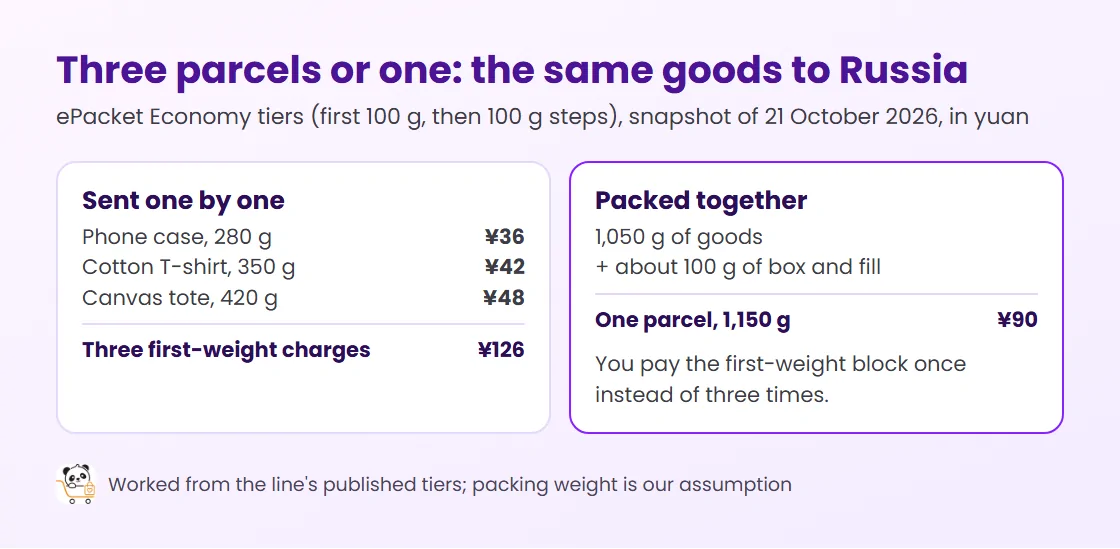
EastGoBuy's guide makes the same point in gentler words: for very light single items, the first weight can be a large share of the postage, so combining is often cheaper. It is not always cheaper. Two heavy items on EMS gain little from sharing a box, and a combined box that goes over 40 cm on a side can trigger volumetric pricing.
Box size: the rule that changes the price
The route notes returned with each line's prices state the size rules. On EMS and e-EMS, once any side of the parcel passes 40 cm, the warehouse works out a volumetric weight (length times width times height in centimetres, over 6,000) and you pay whichever weight is higher. EUB and ePacket Economy do not use volumetric weight but turn away any box whose three sides add up past 90 cm, or whose longest side passes 60 cm.
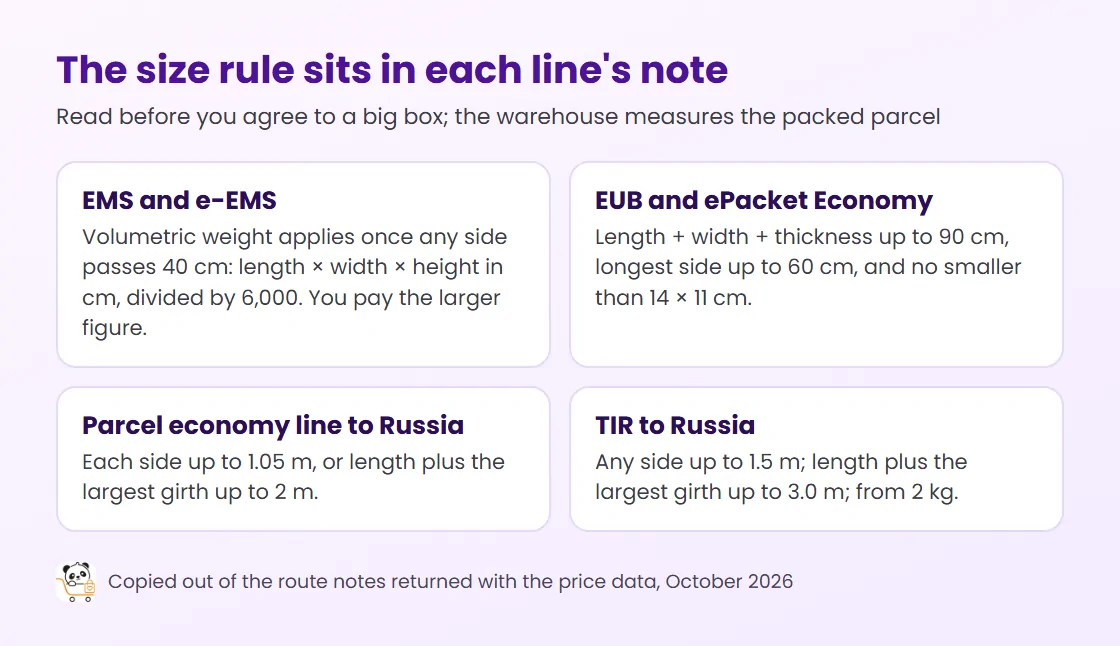
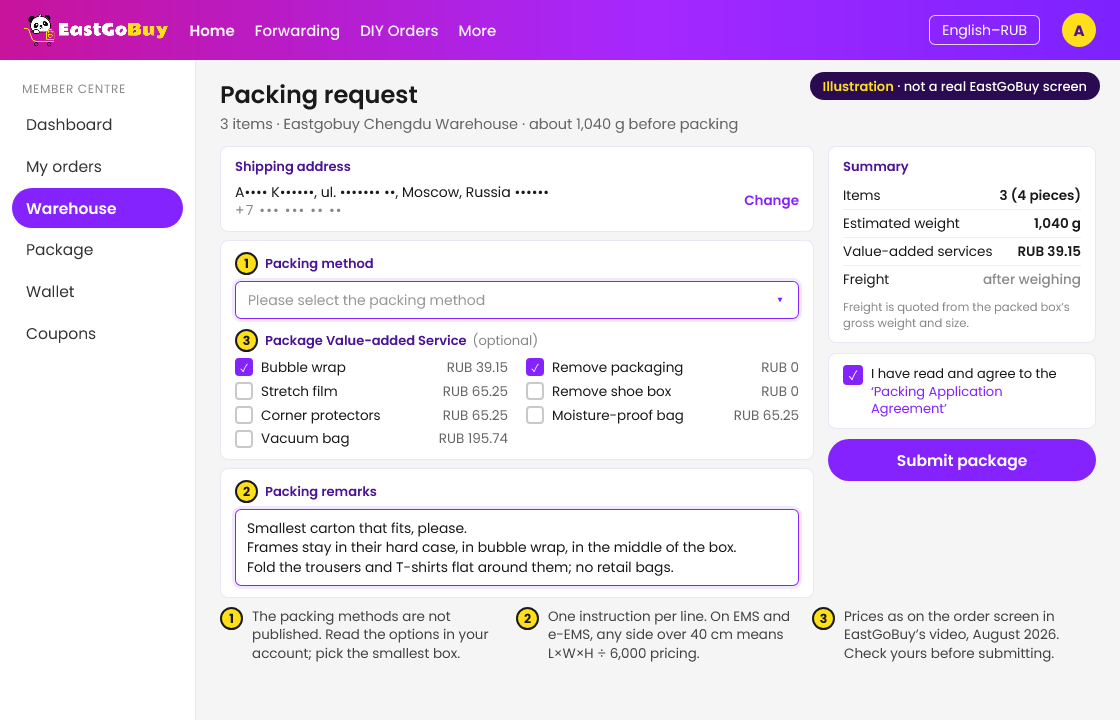
This is why the free "remove shoe box" extra is worth ticking for trainers, and why a puffer jacket benefits from a vacuum bag even at the paid rate: both shrink the box. Ask in the packing note for the smallest carton that fits; the note field is there for that.
Send now or hold for one more arrival
Wait if another order is already marked as shipped by the seller and arrives within your 90 days. Send now if the first item to arrive is close to its free period, if one item is a gift with a date, or if waiting would push a light parcel into a heavier line. A useful habit: write down when your earliest item was stored, and make the call by day 75 at the latest.
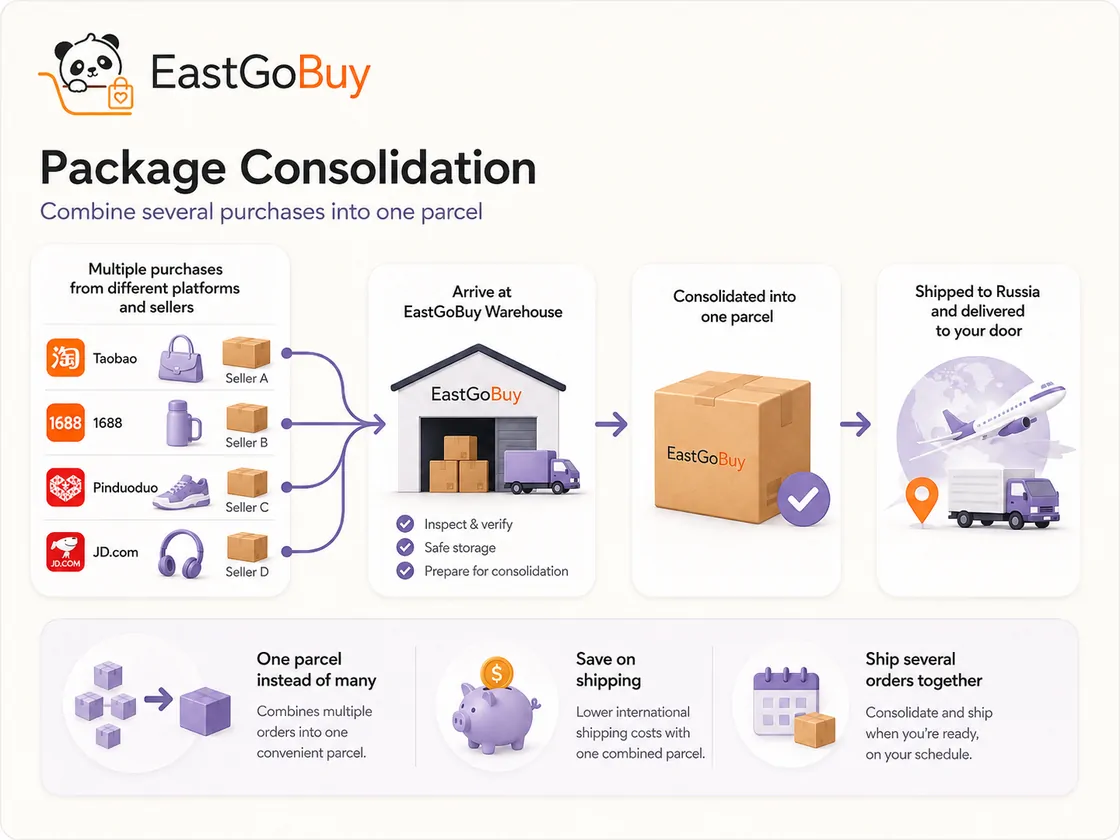
Items must sit in the same warehouse to be packed together; the interface warns "Please select products from the same warehouse" if you mix them. With only the Chengdu warehouse in play, this rarely bites, but it explains the message if you see it.